


5 Litres Relax Pool Total Alkalinity Reducer - Box of 2
*PLEASE NOTE*
This product is not available to order online, please call Customer Services to order
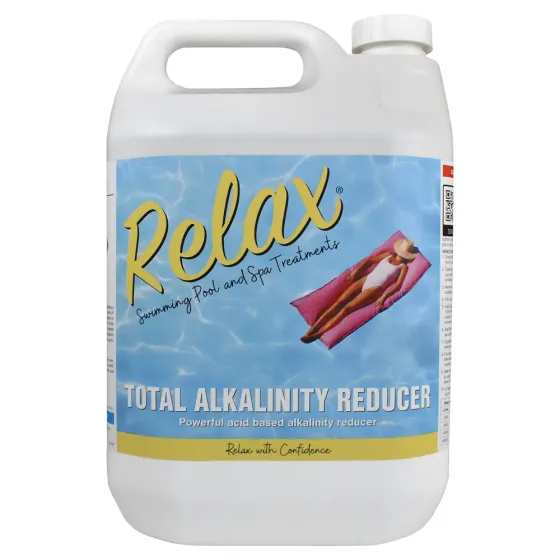

| SKU | RCH504 |
|---|---|
| Re-stock date | Not available online, please call to order |
| Manufacturer | Plastica |
| Hazardous | No |
| EAN | 5055672117216 |
| Single Item Ean | 5055672141426 |
| Complete Box ASIN | B0DLL57PT1 |
| Single Item ASIN | B0DLL77181 |
| Discount Group | T3 |
| Lead Time (Days) | 1 |


Sale and delivery of corrosive products
The Act will restrict access to the most harmful corrosive substances by under 18s by making it an offence to sell a corrosive product, whether over the counter or online, to someone under 18 years of age.
This part of the guidance sets out the statutory obligations placed on retailers, online sellers and marketplaces to ensure that they comply with the law and explains the defences available, which require that all reasonable precautions are taken and all due diligence exercised to avoid committing an offence.
In Scotland, the seller is required to have undertaken a number of specific steps in order to be able to make use of the defence. These would be that seller believed the person to whom the corrosive product was sold to be aged 18 or over, and either the seller had taken reasonable steps to establish the purchaser’s age or no reasonable person, based on the purchaser’s appearance, could have suspected they were under 18. Reasonable steps are prescribed as being that the seller was shown any of the documents listed (a passport, a EU photocard driving licence or such documents that Scottish Ministers may prescribe by order) and the document would have convinced a reasonable person. Following the UK’s exit from the European Union, there is a need to add UK driving licences to the list of prescribed documents. The Scottish Government intends, subject to approval being received from the Scottish Parliament in due course, to add them to the list once the Act has been commenced. This section of the guidance will be revised to list UK driving licences once the changes have come into force.
Definition
For the purposes of sections 1 to 4 of the Act relating to sales and deliveries, the definition of a “corrosive product” is as provided by Schedule 1 of the Act. Schedule 1 lists the particular substances and the concentration limit at which they fall within the definition of “corrosive product” for the purposes of this Act, reproduced in the table below. The definition also includes these substances with a higher concentration than the concentration limit set out in the table.
| Name of substance and Chemical Abstracts Registry Number (CAS RN) | Concentration limit (weight in weight) |
|---|---|
| Ammonium hydroxide (CAS RN 1336-21-6) | 10% w/w |
| Formic acid (CAS RN 64-18-6) | 10% w/w |
| Hydrochloric acid (CAS RN 7647-01-0) | 10% w/w |
| Hydrofluoric acid (CAS RN 7664-39-3) | 0% w/w |
| Nitric acid (CAS RN 7697-37-2) | 3% w/w |
| Phosphoric acid (CAS RN 7664-38-2) | 70% w/w |
| Sodium hydroxide (CAS RN 1310-73-2) | 12% w/w |
| Sodium hypochlorite (CAS RN 7681-52-9) | 10% w/w |
| Sulfuric acid (CAS RN 7664-93-9) | 15% w/w |
The approach to defining corrosive products by substance, chemical abstracts registry number and concentration limit in Schedule 1 provides clarity on the products which will be subject to the new age restrictions on sales. This type of approach is one which should be familiar to retailers and manufacturers and, by setting out the exact substance and the specific concentration limit, this will assist sellers in identifying those products that they may be selling which will be captured by these age restrictions.
The substances and concentrations limits are based on scientific advice provided by the Defence Science and Technology Laboratory and previously from the former Home Office Centre for Applied Science and Technology. The substances defined as corrosive products in Schedule 1 include those which we know have been used in attacks and also those which have the potential to be used as a weapon to inflict serious harm and life changing injuries. The concentration limits reflect the thresholds at which these substances would be most likely to cause potentially permanent or life changing injuries.
Delivery of corrosive products to residential premises
When a corrosive product is sold remotely, section 3 of the Act makes it an offence for the seller to arrange to deliver or arrange for its delivery to residential premises. It is also an offence for the seller to deliver or arrange for its delivery to a locker for collection. The purpose of this section is to ensure that a corrosive product that is sold remotely cannot be delivered into the hands of a person who is under 18 or just left either at the address or a collection point because age cannot then be verified at the point of delivery. This provision also ensures that for remote sales, the purchaser or their representative will be subject to age verification checks when they collect the corrosive product instore or from a collection point.Residential premises
“Residential premises” are defined for the purposes of the Act as premises which are used solely for residential purposes. This definition has been used to ensure that deliveries of corrosive products can be made to businesses that are run from residential premises.
Total Alkalinity Plus
Directions for use
- The total Alkalinity (T.A.) of pool and spa water should be maintained between 80 and 140ppm (parts per million). Add Total Alkalinity Plus when Total Alkalinity of water needs to be increased.
- Use a test kit to determine Total Alkalinity of water.
- Add 16g (2 heaped teaspoons) per 1000 litres to increase total Alkalinity by approx. 10ppm. If your pool holds 40,000 litres of water you will need to add 640g of total Alkalinity Plus to increase the T.A. by 10ppm.
- Always pre-dissolve in a plastic bucket full of water before adding to the pool water.
- Ensure that circulation system is running before pouring the solution into the water immediately above the return inlet.
- Never add product when pool/spa is being used. Allow 15 minutes before using pool/spa.
- After 24 hours test and repeat dose if required.
TA Reducer
Swimming pool water should be maintained at a Total Alkalinity (T.A.) level of between 80ppm – 140 ppm (parts per million). If your pool water is maintained with a T.A. in excess of 140ppm, cloudy water and scaling of pool surfaces are likely. Use a test kit to determine the Total Alkalinity of your pool water; if the test result indicate a T.A. in excess of 140ppm apply Relax Total Alkalinity Reducer as follows:
- Add Relax Total Alkalinity Reducer at a rate of 1ltr per 50,000ltr (11,000 gallons) of pool water to Reduce Total Alkalinity by approximately 10ppm. For example, if your pool water volume is 50,000ltrs and the Total Alkalinity of your pool water is 160ppm, add 4ltrs of Total Alkalinity Reducer to reduce the pool water T.A. to approximately 120ppm.
- Ensure pool circulation pump is running when applying this product. Total Alkalinity is highly concentrated, take care not to allow the product to come into direct contact with your eyes or skin.
- Slowly pour the solution directly from the container into the deep end of your swimming pool, taking care not to allow the product to come into direct contact with the pool surfaces.
- Continue to run the pool circulation pump continuously for 6 hours. Re-test the Total Alkalinity, repeat treatment according to test results until the Total Alkalinity of your pool water has been reduced to approximately 140ppm.
Note: The pH of your pool water will be reduced during this process, however it should recover within a few days of treatment.


